


Productivity is not about doing more but about doing what matters effectively. Highly productive people have mastered habits that enable them to work smarter, not harder. By adopting these habits, you can transform your workflow and accomplish your goals with less stress. Let’s explore these eight habits and practical ways to integrate them into your life.
1. They Review What Worked
Highly productive people take time to reflect on their successes. This practice helps them understand what strategies or actions yielded positive results.
Practical Example:
At the end of each day, create a “Win List” where you jot down three things that worked well. For instance, if you completed a project ahead of schedule because you started with the most challenging task, note it down. This habit will reinforce successful behaviors and keep you motivated.
2. They Recognise What Did Not Work
Acknowledging setbacks isn’t about dwelling on failures—it’s about learning from them. Recognizing what didn’t work allows you to make necessary adjustments and avoid repeating mistakes.
Practical Example:
After missing a deadline, assess why it happened. Was it due to procrastination, underestimating the time required, or poor communication? Document the lesson learned and plan differently for future tasks.
3. They Write Things Down
Productive individuals know that relying solely on memory is a recipe for forgetfulness. Writing things down helps declutter the mind and ensures no critical task is overlooked.
Practical Example:
Use a physical planner or a digital app like Notion or Evernote to jot down your to-do list, appointments, and ideas. For instance, if you think of a new business strategy during a meeting, write it down immediately to revisit later.
4. They Prioritise
Not all tasks are created equal. Highly productive people focus on what matters most and tackle high-priority items first.
Practical Example:
Adopt the Eisenhower Matrix to classify your tasks into four categories:
- Urgent and Important: Tasks to do immediately (e.g., preparing for an important presentation).
- Important but Not Urgent: Tasks to schedule (e.g., long-term planning).
- Urgent but Not Important: Tasks to delegate (e.g., booking travel arrangements).
- Neither Urgent nor Important: Tasks to eliminate or postpone (e.g., scrolling social media).
5. They Plan
A clear plan ensures you start each day with purpose and direction. Planning prevents wasted time and keeps you aligned with your goals.
Practical Example:
Dedicate 10 minutes each evening to planning the next day. List 3-5 key tasks you aim to complete, and schedule them in time blocks. For instance, allocate 9-11 AM for writing a report and 2-3 PM for client follow-ups.
6. They Set Boundaries
Saying “no” is essential for maintaining focus. Productive people protect their time and energy by setting clear boundaries.
Practical Example:
If you’re frequently interrupted at work, set “focus hours” when you turn off notifications and let colleagues know you’re unavailable. For example, block 10 AM to 12 PM daily for deep work, ensuring you complete critical tasks without distractions.
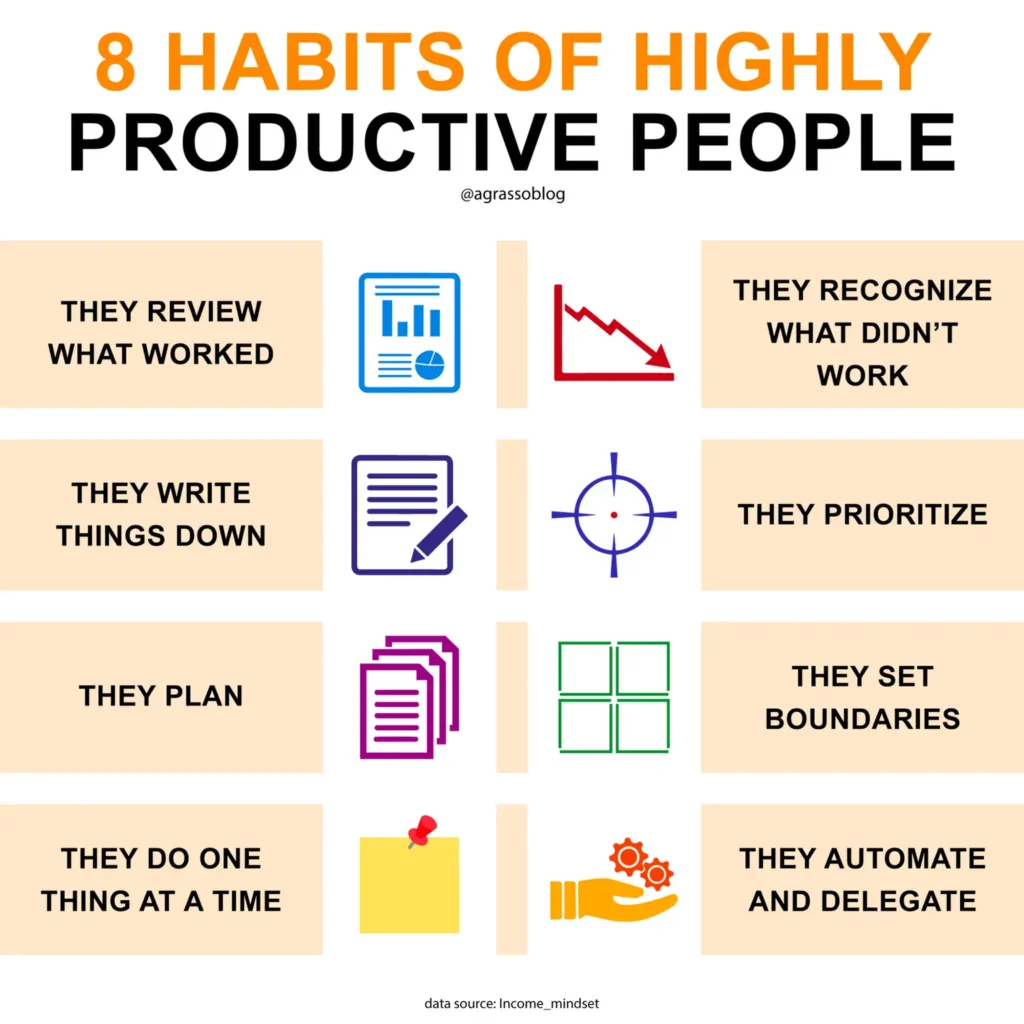
7. They Do One Thing at a Time
Multitasking may seem productive, but it often leads to errors and burnout. Highly productive people focus on one task at a time, giving it their full attention.
Practical Example:
Use the Pomodoro Technique: Work on a single task for 25 minutes, then take a 5-minute break. For instance, when responding to emails, avoid switching between tasks like writing reports or attending meetings.
8. They Automate and Delegate
Time is a finite resource, so productive people use tools and teamwork to free up their schedules for more meaningful work.
Practical Example:
- Automation: Use software like Zapier to automate repetitive tasks, such as sending email reminders or organizing files.
- Delegation: Assign administrative tasks to an assistant or freelancer. For instance, if creating PowerPoint slides consumes too much time, delegate it to a skilled professional.
Final Thoughts
By incorporating these eight habits into your daily routine, you’ll find yourself achieving more with less effort. Start small—pick one or two habits to focus on initially, and build from there. Remember, productivity is a journey, not a destination.
Which of these habits are you excited to try? Let us know in the comments below!
Staff Scheduling with Time and Attendance Tracking | Unrubble
Leave a Reply